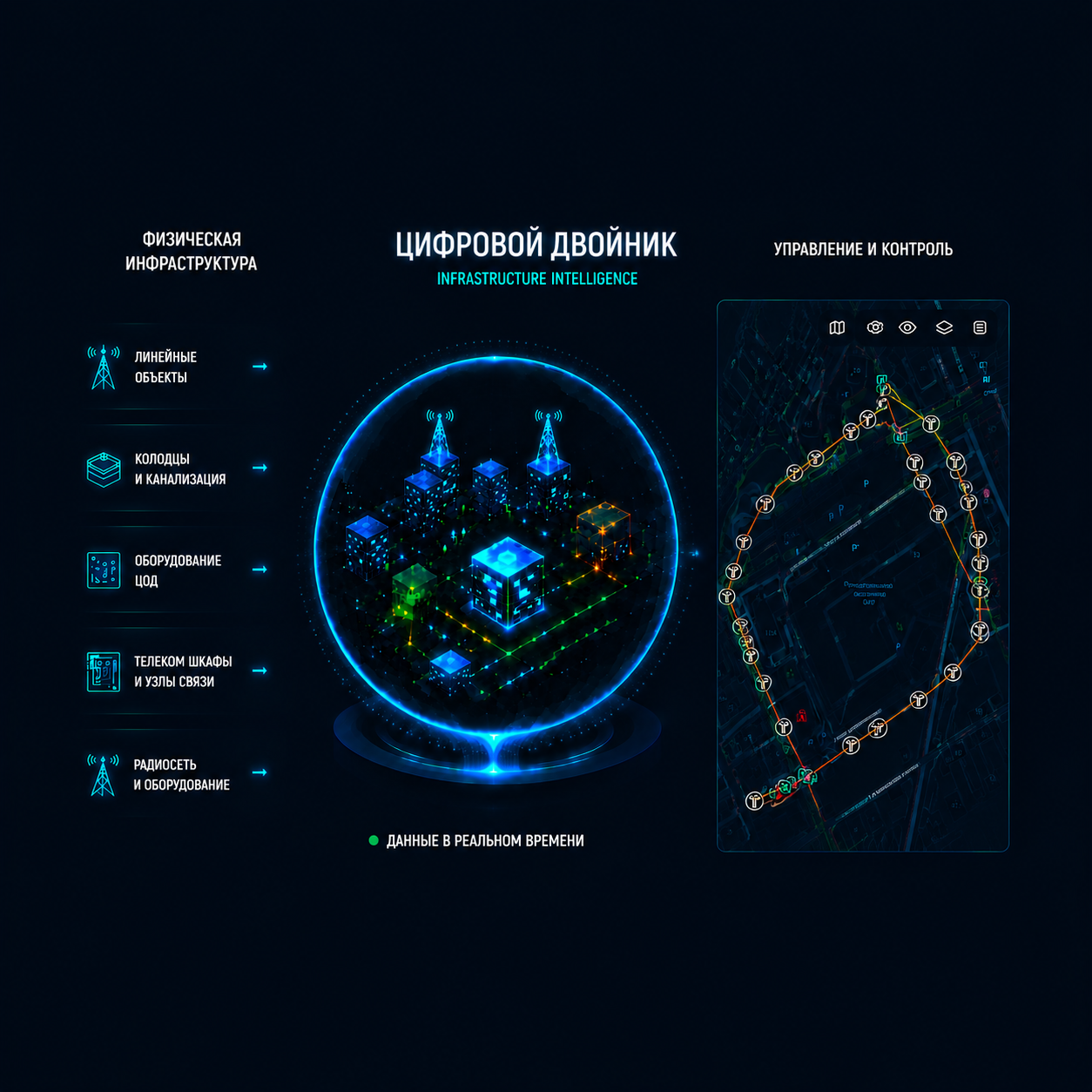
Imagine having an exact digital copy of your entire infrastructure — from cable routes to data center equipment. Not just a diagram, but a living model where every port, every connection, and every customer are linked into a single system. This is exactly the capability offered by a class of solutions known as NRI (Network Resource Inventory) — systems for technical inventory and infrastructure management.
For many companies, especially in telecom, energy, and utilities, infrastructure management is a critical challenge. Outdated systems, siloed data, manual operations — all of this creates risks and drives up costs. According to industry data, the level of digitalization in Russia's utilities sector stands at about 10%, illustrating the scale of the problem. Technical inventory systems are becoming not just a convenient tool but a necessity, particularly given the requirements for Critical Information Infrastructure (CII) facilities.
For many companies, especially in telecom, energy, and utilities, infrastructure management is a critical challenge. Outdated systems, siloed data, manual operations — all of this creates risks and drives up costs. According to industry data, the level of digitalization in Russia's utilities sector stands at about 10%, illustrating the scale of the problem. Technical inventory systems are becoming not just a convenient tool but a necessity, particularly given the requirements for Critical Information Infrastructure (CII) facilities.
Why Does Business Need a Digital Twin?
Technical inventory is not just equipment tracking. It's the ability to see the full picture: how physical infrastructure connects to services and customers. Modern NRI systems address challenges that many companies face:
- Moving away from outdated approaches. Non-specialized software, foreign solutions with sanctions risks and high licensing fees, as well as legacy systems with manual operations — all of these are becoming a thing of the past. The primary goal of the Russian software registry is to reduce dependence on foreign IT products, and using solutions from the registry offers companies tax benefits and other advantages.
- Regulatory compliance. Digital twin and technical inventory systems fall under CII entities according to Russian Government Directive No. 360-r dated February 26, 2026. Using software included in the Ministry of Digital Development's registry helps meet regulatory requirements.
Key Capabilities of a Modern NRI System
A modern technical inventory solution is not a monolithic program but a modular system that can be adapted to the specific needs of any business. Let's explore the main functional blocks using the InfraMirror NRI platform as an example:
- Linear asset management. Cable lines, laying routes, poles, suspensions, conduits, and manholes — all of these can not only be tracked but also configured with a custom configurator for any type of linear asset. This is especially important for telecom operators and energy companies with extensive network infrastructure.
- Radio network. Automatic calculation of coverage zones based on equipment metrics and integration with existing calculation tools enable network development planning and performance optimization.
- Service, customer, and infrastructure connectivity. One of the key functions is the ability to see which customer is connected to which equipment port, and how services are inherited from downstream devices. Integration with the billing system makes this process transparent and automated.
- Data center equipment tracking. Top-view floor plans, 2D front and rear rack views, equipment placement (including small devices and batteries), cabling, and lifecycle support system tracking — all of this enables detailed data center management.
- Asset passports. Interactive wiring diagrams and cable/fiber-optic line tracing make engineers' work more visual and efficient.
- Structured sections. Equipment tracking, parameters, attributes, metrics, port models, connections and links, change history, services, and customers — all information is structured and accessible through a unified interface.
Technology Advantages
Modern NRI solutions are built on a microservices architecture. This ensures fault tolerance, scalability, and ease of integration with billing, ERP, monitoring systems, and device management. Such an architecture allows load distribution across servers, creation of geo-distributed clusters, and redundancy.
The interface of these systems is modern web-based and cross-platform, enabling work from anywhere without installing heavy desktop applications. Unlike monolithic systems that require custom development for each client, a flexible configurator allows for quick startup and rapid modifications.
The interface of these systems is modern web-based and cross-platform, enabling work from anywhere without installing heavy desktop applications. Unlike monolithic systems that require custom development for each client, a flexible configurator allows for quick startup and rapid modifications.
Security and Reliability
Security is a top priority, especially for companies operating CII facilities. Modern NRI solutions provide:
- Token-based API authentication — only authorized users can access the system.
- Automated test coverage of the codebase, enhancing resilience to failures.
- Support for DBMS from the Russian software registry, ensuring compliance with security requirements.
Implementation Practice
Implementing an NRI system is not just software installation but a comprehensive process that includes:
- Analyzing the technical requirements and client infrastructure — to understand the current state and needs.
- Solution design and configuration — tailoring the system to specific tasks.
- Software installation and setup — deployment by specialists.
- Data migration and integration with BSS/OSS/ERP — to ensure the system works with existing data and processes.
- Staff training and go-live — so the team can effectively use the new tool.
What's Next?
The development of NRI solutions continues. Future plans include expanding the data center tracking module, introducing an AI assistant, AI-powered network design, and transitioning to a SaaS model.
Technical inventory is no longer a mundane obligation — it is becoming a strategic management tool. Companies that adopt modern NRI systems gain not just an equipment database but a full-fledged digital twin of their infrastructure, helping them make informed decisions, reduce risks, and improve business efficiency.
Technical inventory is no longer a mundane obligation — it is becoming a strategic management tool. Companies that adopt modern NRI systems gain not just an equipment database but a full-fledged digital twin of their infrastructure, helping them make informed decisions, reduce risks, and improve business efficiency.