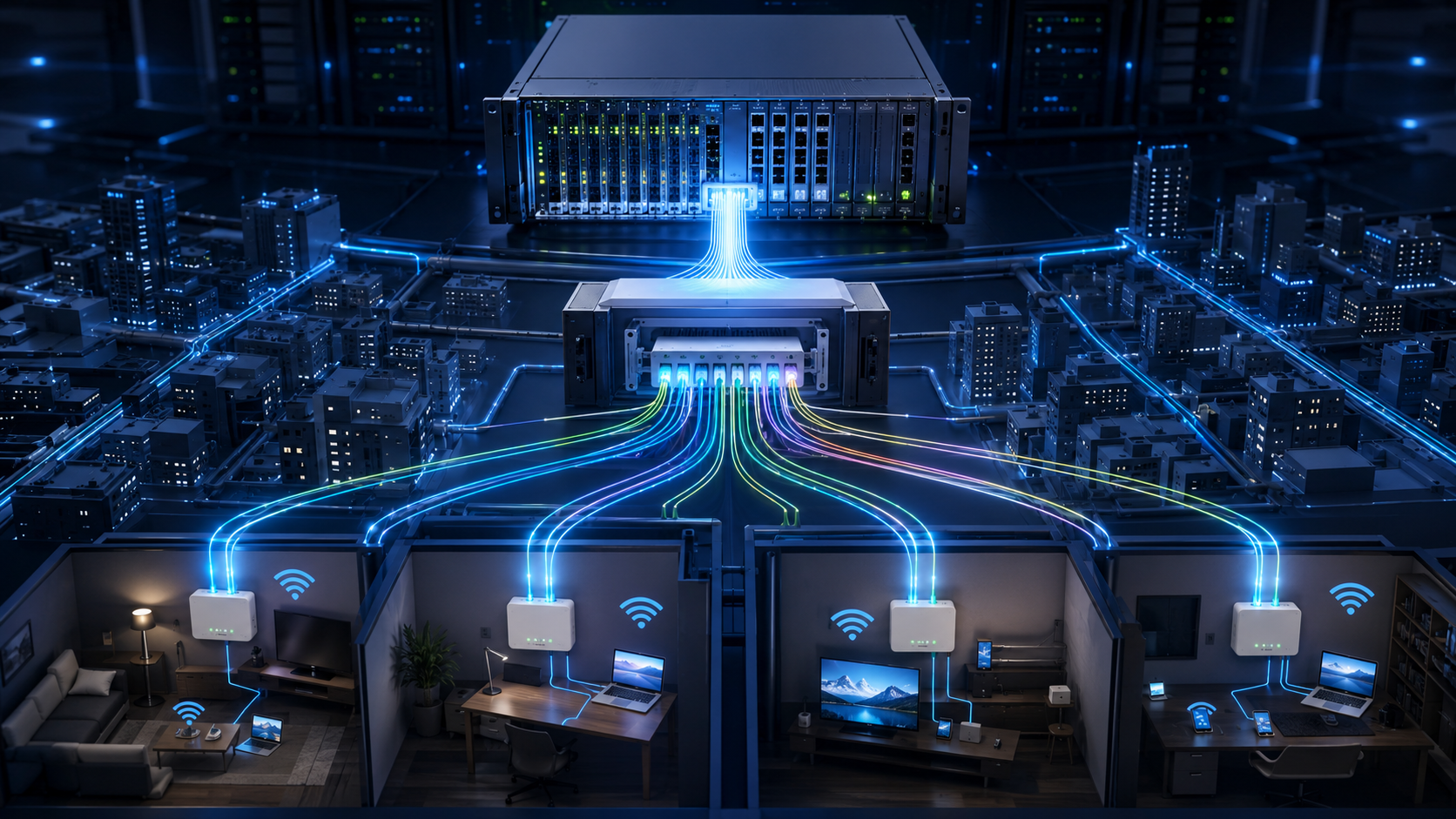
Imagine this: a single optical fiber enters your home, delivering not only gigabit Internet access but also IPTV and voice services. The same approach scales to every apartment and every office. It's not magic—it's GPON technology, powered by sophisticated network engineering. Let's take a closer look at how it works, from the powerful "brain" at the central office to the compact ONT device installed at the subscriber's premises.ntcagfhsdkvsdbhvk
What Is GPON and Why Is It Beneficial?
GPON (Gigabit Passive Optical Network) is the global standard for building Fiber-to-the-Home (FTTH) access networks. Its key advantage is that the network between the service provider and the subscriber is built using passive optical components.
What does this mean in practice? At intermediate points—such as inside an apartment building—there is no active equipment that requires power, cooling, or ongoing maintenance. Instead, the network uses simple, highly reliable optical splitters, which divide a single optical signal and distribute it to multiple subscribers.
For network operators, this architecture offers significant advantages: lower capital and operating costs, reduced power consumption, higher network reliability, and the ability to scale the access network quickly and efficiently.
What does this mean in practice? At intermediate points—such as inside an apartment building—there is no active equipment that requires power, cooling, or ongoing maintenance. Instead, the network uses simple, highly reliable optical splitters, which divide a single optical signal and distribute it to multiple subscribers.
For network operators, this architecture offers significant advantages: lower capital and operating costs, reduced power consumption, higher network reliability, and the ability to scale the access network quickly and efficiently.
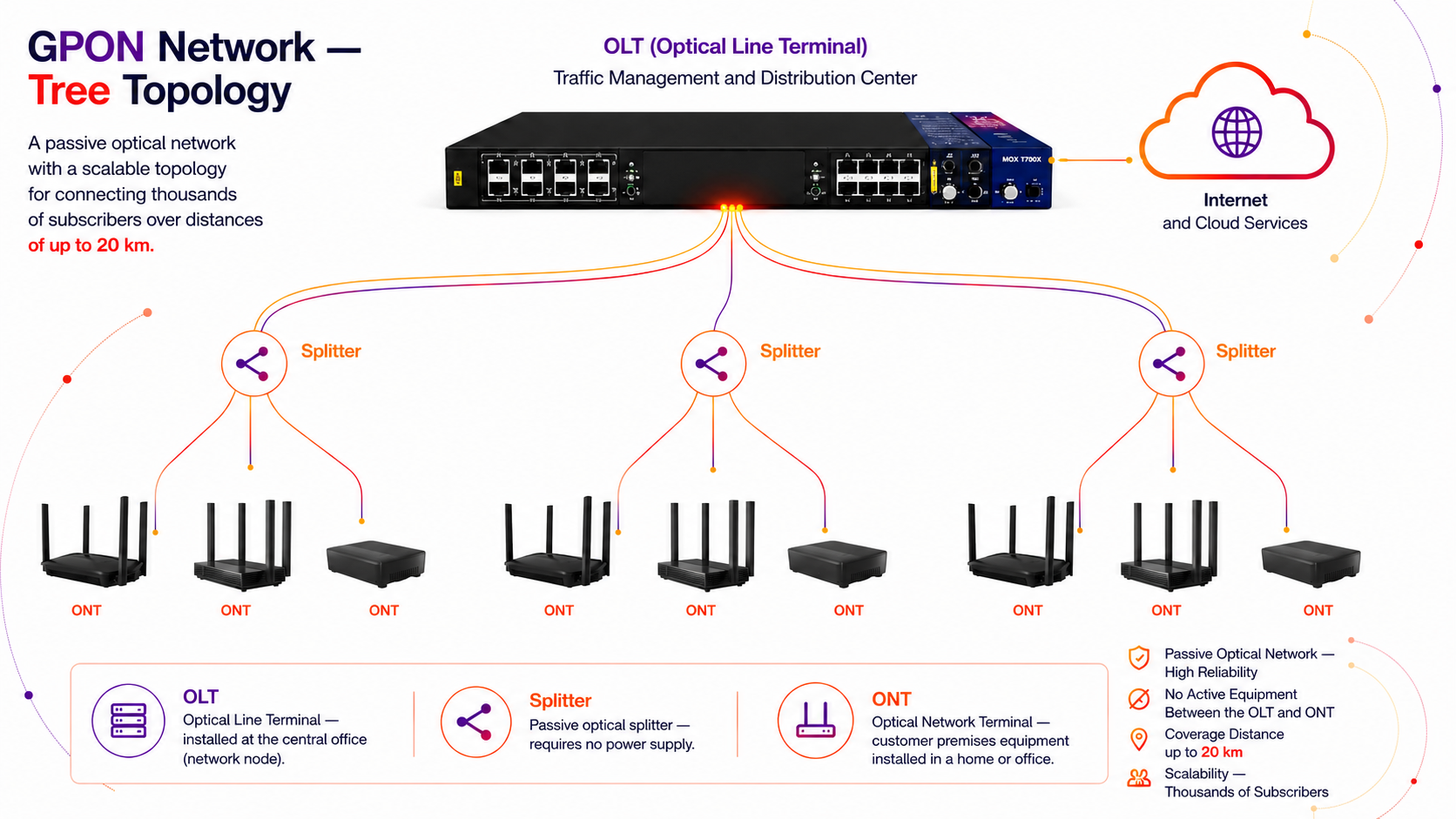
A GPON network always follows a tree topology, with a high-performance Optical Line Terminal (OLT) at the root and Optical Network Terminals (ONTs) installed at the endpoints on the subscriber side.
The Heart of the Network: The Optical Line Terminal (OLT)
It is the brain and the heart of the entire access network. The Optical Line Terminal (OLT) is a high-performance platform installed at the operator's central office or point of presence (PoP). Its primary role is to aggregate traffic from thousands of subscribers and forward it to the core network, while also distributing downstream traffic from the Internet to all connected homes and businesses.
Morion Networks OLT devices are engineered to meet the most demanding requirements of carrier-grade networks, delivering high performance, reliability, and scalability for modern FTTH deployments.
Morion Networks OLT devices are engineered to meet the most demanding requirements of carrier-grade networks, delivering high performance, reliability, and scalability for modern FTTH deployments.
Key Benefits for Network Operators:
- High Capacity: A single OLT port can serve 64 or more subscribers, while a single OLT chassis can support up to 72 PON ports. This means that just one platform installed at the provider's central office can deliver broadband connectivity to an entire residential district.
- Centralized Management and Control: The OLT serves as the network operator's control center. It provides complete visibility into the access network, enables Quality of Service (QoS) management, and allows traffic prioritization. As a result, latency-sensitive applications such as online gaming remain responsive even when other users are streaming 4K video simultaneously.
This is where the subscriber's data journey begins—at the OLT, where traffic is processed and transmitted into the passive optical network toward the end user.
The Distribution Network: ODN and Passive Optical Splitters
From the OLT, one or more high-capacity optical fibers extend into the access network. These fibers form the optical distribution network (ODN) and serve as the network's feeder infrastructure. They terminate at a fiber distribution cabinet or within an apartment building, where the optical signal is divided by a passive optical splitter and distributed to multiple subscriber connections.
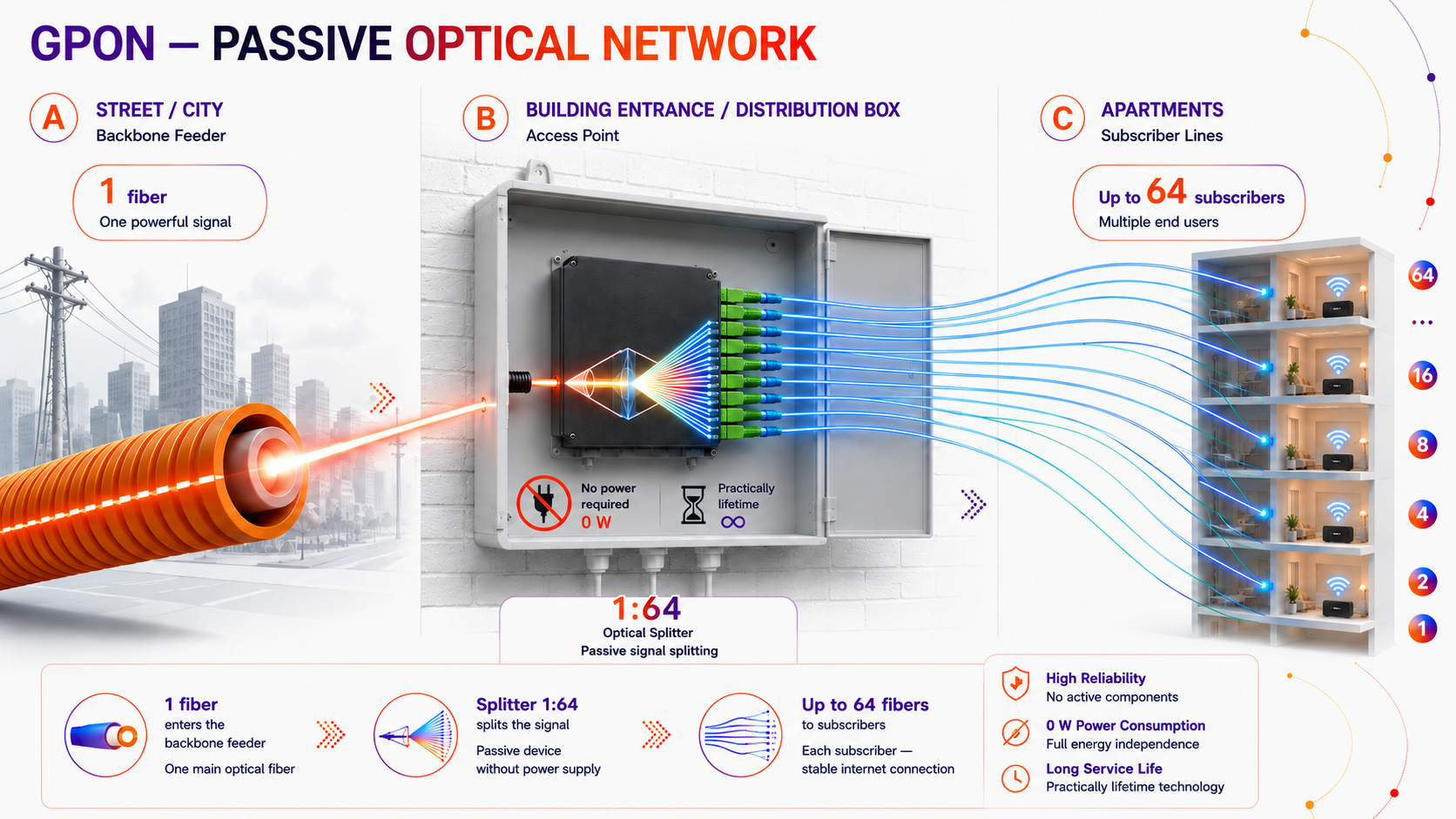
Imagine a single optical fiber being split into 16, 32, or even 64 individual fiber connections, each serving a different home or office. The remarkable part is that the passive optical splitter requires no electrical power, contains no active electronics, and has an exceptionally long service life. It simply divides the incoming beam of light and distributes it to every subscriber on the PON.
This passive architecture is one of the key reasons why GPON is so cost-effective: by eliminating active equipment in the outside plant, operators significantly reduce deployment costs, power consumption, and ongoing maintenance expenses.
This passive architecture is one of the key reasons why GPON is so cost-effective: by eliminating active equipment in the outside plant, operators significantly reduce deployment costs, power consumption, and ongoing maintenance expenses.
The Last Mile: The Optical Network Terminal (ONT)
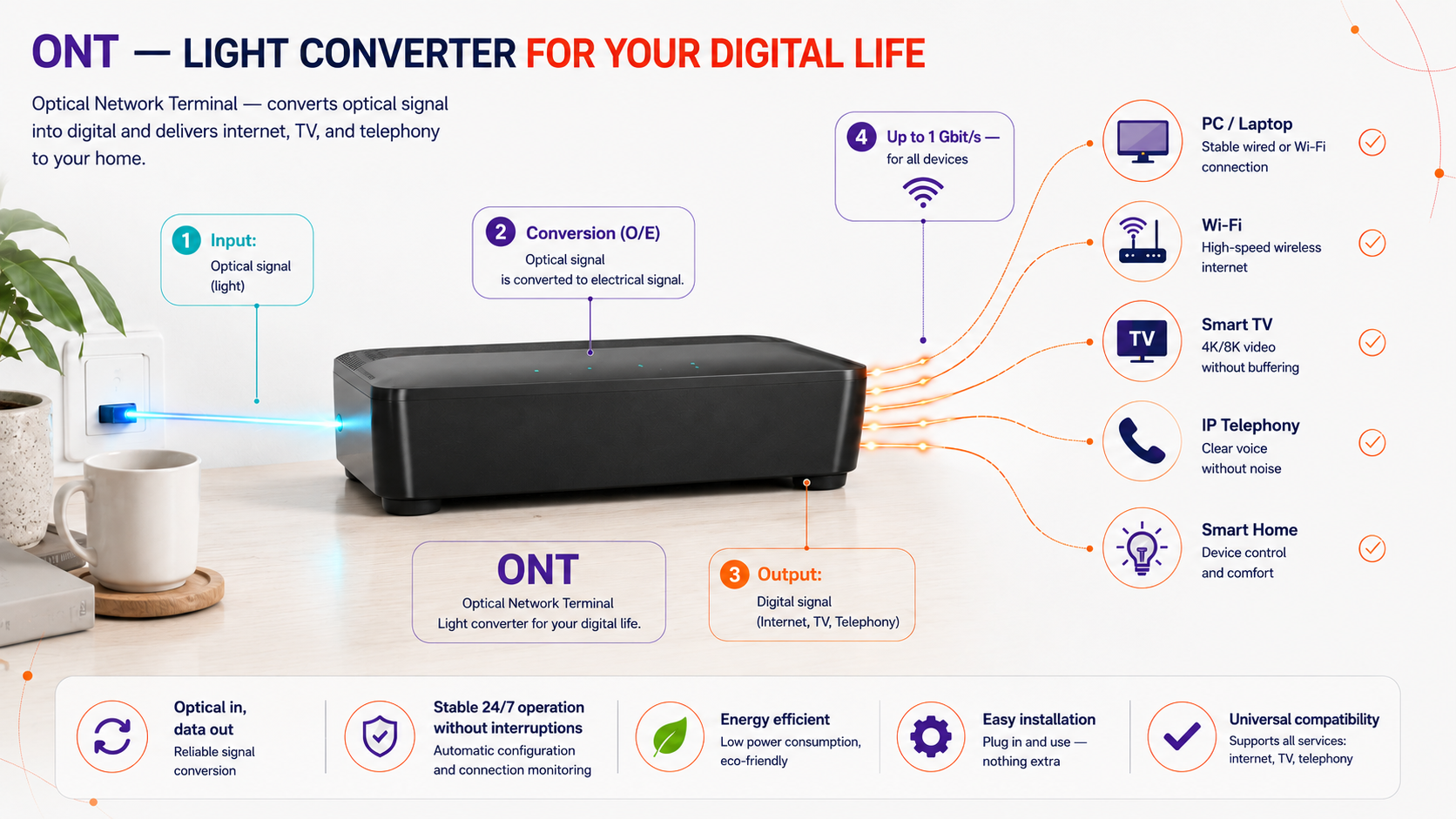
The Optical Network Terminal (ONT) is the final point in the GPON access network—the compact device installed in a subscriber's home or office. It receives the optical signal transmitted through the passive optical network and converts it into standard electrical Ethernet interfaces that can be used by end-user devices.
The ONT is where subscribers connect their computers, smart TVs, IP phones, or Wi-Fi routers, enabling seamless access to high-speed Internet, IPTV, and voice services.
Morion Networks ONT devices are designed to deliver reliable, high-performance connectivity, ensuring stable operation of all subscriber services while meeting the demands of modern broadband networks.
The ONT is where subscribers connect their computers, smart TVs, IP phones, or Wi-Fi routers, enabling seamless access to high-speed Internet, IPTV, and voice services.
Morion Networks ONT devices are designed to deliver reliable, high-performance connectivity, ensuring stable operation of all subscriber services while meeting the demands of modern broadband networks.
What Matters to Us as a Vendor:
- End-to-End Compatibility: Our ONT devices undergo rigorous validation and interoperability testing with Morion Networks OLT platforms. This end-to-end approach ensures seamless integration, stable operation, and reliable service delivery throughout the access network.
- Intelligence at the Network Edge: A modern ONT is much more than a simple media converter. It supports remote management via the TR-069 protocol, enabling operators to provision devices, update firmware, modify configurations, and troubleshoot subscriber issues remotely—eliminating the need for costly on-site service visits.
- A Complete Triple-Play Solution: Our ONT devices provide more than Ethernet connectivity. Depending on the model, they can function as a Wi-Fi access point and include voice (FXS) ports for IP telephony, allowing operators to deliver Triple Play services—high-speed Internet, IPTV, and voice—over a single optical fiber.
The Architecture and Operator Benefits — The Morion Networks Perspective
At Morion Networks, we don't simply offer an OLT and an ONT as separate products. We deliver a fully integrated hardware and software platform, where every component is designed to work together as a unified system. This end-to-end integration ensures seamless interoperability, simplified network management, and the reliable, predictable performance that operators expect from a carrier-grade GPON solution.
- Local Technology and Long-Term Reliability: Today, technological independence and supply chain stability are more important than ever. Morion Networks OLT and ONT platforms are developed in Russia and are already deployed in the networks of major service providers, including ER-Telecom Holding, AKADO Telecom, and Novotelecom. We are committed to providing a long product lifecycle, continuous software support, and compliance with the stringent requirements of carrier-grade network deployments.
- Simplified Network Management: Our software platform gives operators end-to-end visibility across the entire access network—from the subscriber's ONT and home gateway to the central-office OLT. This unified management approach streamlines network monitoring, inventory management, service provisioning, and subscriber administration.
- Lower Total Cost of Ownership: The combination of high-density OLT platforms, a passive optical network architecture, and remote management of customer premises equipment (CPE) significantly reduces both CAPEX (capital expenditures) and OPEX (operating expenditures), enabling operators to deploy and operate broadband networks more efficiently and cost-effectively.
Conclusion
GPON has become the benchmark for building high-performance, reliable, and scalable fiber access networks. Its passive architecture, combined with centralized management and outstanding cost efficiency, enables service providers to deploy broadband infrastructure that is ready to meet both current and future demands.
At Morion Networks, we do more than manufacture GPON equipment—we develop complete, carrier-grade solutions that integrate seamlessly into a unified ecosystem. From OLT platforms at the central office to ONT devices at the subscriber premises, every component is designed to work together, delivering reliability, operational efficiency, and long-term investment protection.
Our goal is to provide operators with the technology they need to build robust, future-ready FTTH networks—so subscribers can simply enjoy fast, stable, and uninterrupted connectivity without ever having to think about the sophisticated infrastructure that makes it all possible.
At Morion Networks, we do more than manufacture GPON equipment—we develop complete, carrier-grade solutions that integrate seamlessly into a unified ecosystem. From OLT platforms at the central office to ONT devices at the subscriber premises, every component is designed to work together, delivering reliability, operational efficiency, and long-term investment protection.
Our goal is to provide operators with the technology they need to build robust, future-ready FTTH networks—so subscribers can simply enjoy fast, stable, and uninterrupted connectivity without ever having to think about the sophisticated infrastructure that makes it all possible.